
Latest entries
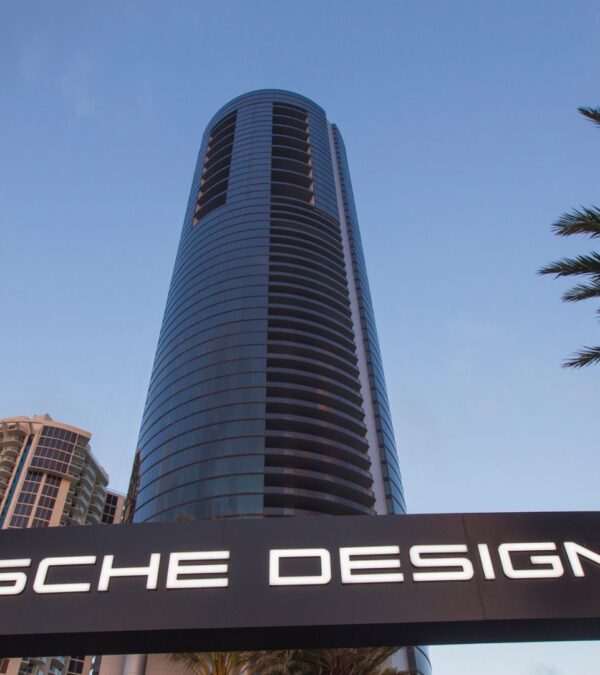
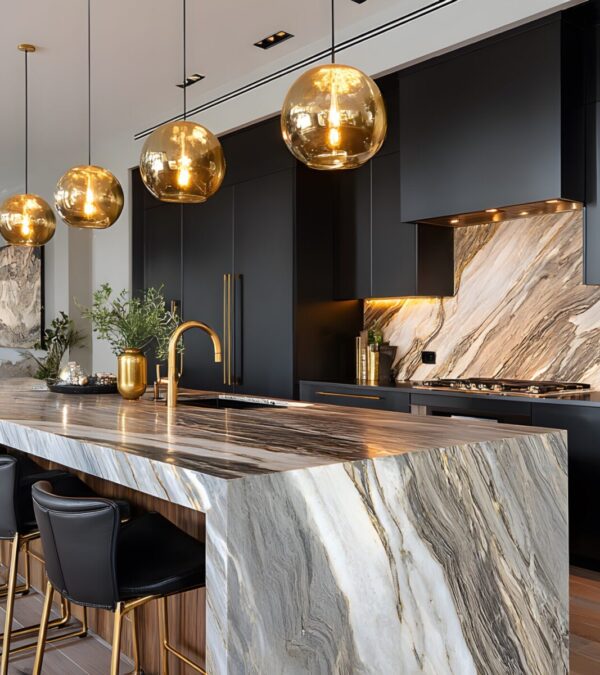
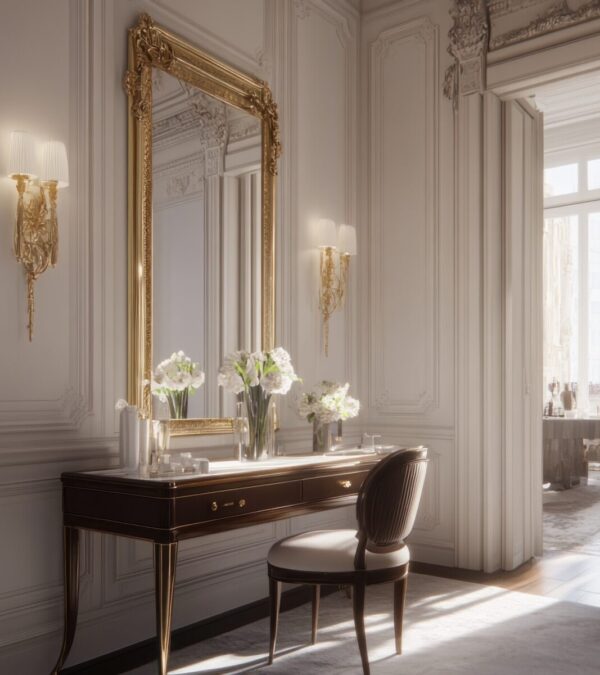
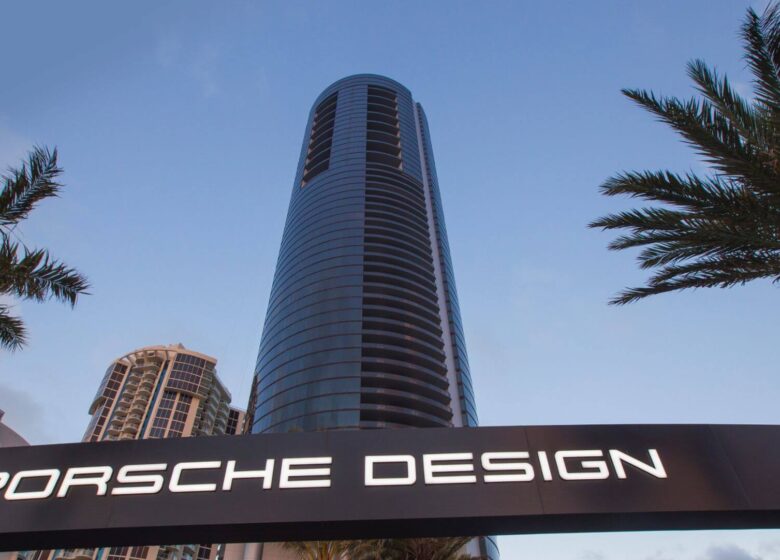
In Sunny Isles Beach, Florida, stands a 65-storey skyscraper that has redefined the concept of luxury property. Not because it is tall. Not because every balcony offers a view of the Atlantic. But because residents can drive their cars right up to their own flat. The Porsche Design Tower Miami is a building that has become a symbol of the phenomenon known as branded residences — and one of the most frequently cited examples of where luxury in property might be heading.
Dezer’s project and a garage in the clouds
The Porsche Design Tower is a joint project by developer Gil Dezer and the Porsche Design Group, announced in 2012 and completed a few years later. The building houses 132 residences ranging in size from almost 400 to over 1,500 square metres. Each comes with a private garage — not on the ground floor, but on the owner’s own floor. This is made possible by a patented car lift, dubbed the Dezervator by the developer. The owner drives their car onto the platform at the entrance, the doors close, and within 75 seconds they arrive directly at their own front door — whilst still sitting behind the wheel. Four parking spaces per apartment, a glass wall between the garage and the living room, two penthouses priced at $32.5 million each.
This is not an architect’s fantasy, but an answer to a very specific question: how do you sell a property to a client who already has everything? The answer is — give them something they cannot find anywhere else. And it is precisely this logic that underpins the entire branded residences market.
What exactly are branded residences?
Branded residences are residential properties — apartments, villas or entire complexes — created through a formal partnership between a developer and a recognised global brand. The brand brings its name, aesthetic, know-how and — crucially — a loyal customer base. The developer provides the land, financing and construction expertise. The buyer receives a property that is simultaneously a luxury product, a statement of identity and a financial investment.
The collaboration takes various forms. Hotel chains such as Four Seasons, Ritz-Carlton and Mandarin Oriental build private apartments adjacent to their hotels, whose owners enjoy full hotel services — concierge, spa, restaurants — around the clock. Fashion houses such as Versace, Fendi Casa and Dolce & Gabbana design interiors and communal spaces in line with their own aesthetic. Automotive brands — Porsche, Lamborghini, Aston Martin, Bugatti — go beyond the car and build worlds in which their customers can literally live.
The history of the segment is longer than one might think. The first branded residence is considered to be the Sherry-Netherland hotel in New York, opened in 1927 — a building combining private apartments with hotel services in Manhattan. For decades, the concept developed slowly. The real breakthrough came in the 1980s, when hotel chains realised that a brand could be a financial asset even outside the hospitality industry. Since then, the market has not stopped for a moment.
Global scale — impressive figures
According to the latest Knight Frank Global Branded Residence Survey report from 2025, there are currently over a thousand branded residence projects in 83 countries, bearing the names of nearly 80 different brands. Earlier forecasts predicted 55 per cent growth in the segment by 2026 — and all the evidence suggests that these estimates were conservative rather than overestimated. Buyers pay between 25 and 35 per cent more for this type of property than for a comparable unbranded property. In the ultra-premium segment, this premium is even higher.
Geographically, the market is currently concentrated in a few hubs. Dubai is the city with the highest number of projects under construction — the Bugatti Residences by Binghatti building stands 43 storeys tall, and one of its penthouses was sold for $54 million. The United States remains the global leader in terms of the total number of projects. Europe — particularly London, Barcelona and the Costa del Sol — is seeing dynamic growth, driven by wealthy clients from the Middle East, Asia and Latin America. Design Hills by Dolce & Gabbana in Marbella — 92 apartments designed by the Italian fashion house — achieved sales exceeding €250 million within seven months of its launch.
The Ritz-Carlton and Four Seasons remain the leaders among brands in terms of the number of active projects. The fastest-growing are Aman and Six Senses — brands that have focused on exclusivity, off-the-beaten-track locations and a clientele seeking more than just a prestigious address. Among brands outside the hospitality sector, car manufacturers lead the way: Porsche, Lamborghini, Aston Martin, Bentley and Bugatti — each with its own interpretation of what a luxurious life beyond the car should be.
Why it works — the psychology of the brand premium
One might ask why someone would pay a third more for a suite bearing a familiar logo. The answer is multi-layered. Firstly — risk reduction. The buyer knows what to expect from a Mandarin Oriental or Four Seasons product. The brand is a promise of quality, which the licensor has every interest in delivering. Secondly — services that cannot be replicated. A private concierge, property management whilst the owner is away, access to a spa and restaurants at a standard defined by a luxury brand — this is a promise that a developer without a global partner would be unable to deliver. Thirdly — secondary market liquidity. Properties bearing a recognisable brand are easier to sell and let, and their value holds up better during economic downturns.
There is also a dimension that no report explicitly captures: a sense of belonging. An owner of a flat in Four Seasons Private Residences is not buying square metres — they are buying an identity, a network, a community of like-minded people. It is the same mechanism that has been driving sales of watches and cars in the ultra-premium segment for decades. Branded residences simply transfer this to property.
Poland — where are we and where are we heading?
Against the backdrop of the global boom, Poland’s position is clear: we are a maturing market that has all the foundations for this trend, but as yet no branded residence project in the classic sense of the term. CBRE experts point out that Warsaw’s luxury sector is currently developing in the spirit of local identity and high-quality finishes — not imported branding. In this respect, we are closer to Prague and Budapest than to Paris or London.
At the same time, the conditions are stronger than ever before. According to a report by Henley & Partners, the number of millionaires in Poland has risen by 83 per cent over the last decade — one of the highest rates in Europe. Warsaw is consolidating its position on the continental map of premium cities, and prices in the most prestigious locations — Śródmieście, Powiśle, and the area around Łazienki Park — are already exceeding 70,000 zlotys per square metre. Polish investors are buying property in Dubai, Marbella and Barcelona — and they know full well what branded residences are from their own experience as buyers.
The market is sending out its first signals. Developments such as Liberty Tower by Cavatina in Warsaw offer wellness zones, spas, cinemas and cigar lounges — a standard of service previously unknown in Polish residential skyscrapers. This is not yet a branded residence, but a clear step in that direction: thinking of property as an experience, not just as space. The managed rental and premium property segment is growing rapidly — and it is precisely this operational infrastructure that no branded residence project can function without. Owners who entrust their properties to professional rental management are laying the foundations for this market today.
Will branded residences be built in Poland?
The answer is yes — and the question is more about when than if. Several factors will determine this. The first is the inflow of foreign investment capital — it is institutional investors who attract global developers, and they bring brand licences with them. Poland is an increasingly attractive destination for capital from Western Europe and the Gulf region. The second factor is further consolidation of the luxury market — the greater the concentration of affluent buyers in specific locations, the stronger the case for a global brand to invest there. The third, equally important factor: the maturity of the letting and property management infrastructure. Branded residences require an operator capable of maintaining the brand’s standards — and the number of such operators in Poland is growing.
The most likely locations for the first branded residences in Poland remain Warsaw — particularly Śródmieście and Powiśle — as well as the Tri-City and Kraków, where the cities’ tourist appeal and the presence of affluent visitors from outside create a natural foundation for this type of investment. Investors interested in this segment should act now — selecting properties in locations that will be at the heart of this trend in a few years’ time, and ensuring they receive premium-level service from day one.
The future — luxury as a service
Branded residences are not a whim — they are a response to a deeper shift in the way affluent people think about property ownership. It is increasingly less about the floor area, the address or even the view from the window. It is increasingly more about what is happening around it: who manages the building, what services are available, what kind of community the neighbours form, and what lifestyle the property enables. In this sense, branded residences are not so much a new product on the property market as a new definition of luxury living.
Poland is maturing towards this definition at its own pace — and that pace is faster than one might think. For investors who understand this direction, the present moment — before the trend fully reaches Warsaw or Kraków — may prove to be the most interesting. Find out how Vilea Property Boutique helps owners of premium properties build the value of their investments — today and with a view to what lies ahead.
Autor: Adrian Kołodziej
Managing Director
Vilea Property Boutique