
Latest entries
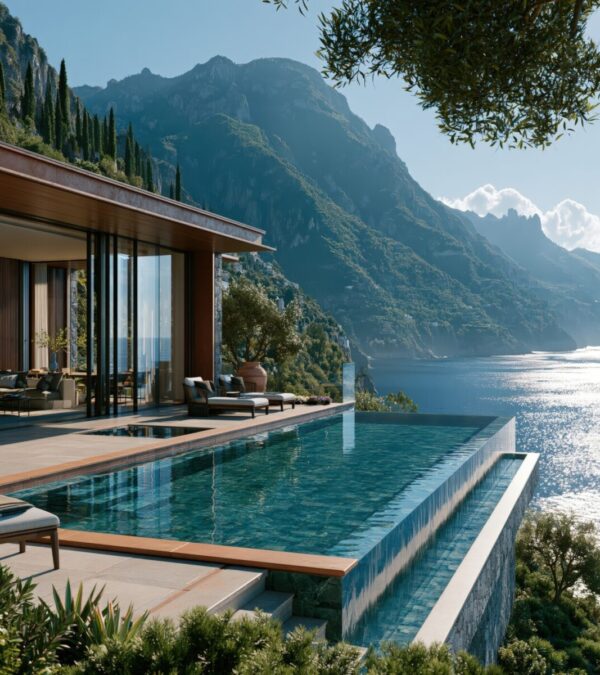


Robb Report described Larry Ellison’s Palm Beach estate in a single sentence: even by billionaire standards, it is more of a private resort than a home. Fifteen acres between the ocean and the lake, a 62,200-square-foot residence, 1,200 feet of private beach, a PGA-standard golf course, a spa, tennis courts, a swimming pool and an underground tunnel connecting the two parts of the estate — designed as an art gallery. This is not a house with amenities. It is a resort where, by chance, someone lives. And it is precisely this model of living — one’s own private resort as the primary form of residence for the wealthiest — that has become one of the most significant trends in the global ultra-premium property market in recent years.
What is a private resort home — a philosophy, not a standard of finish
The concept of a private resort home is more than just a list of amenities. It is a philosophy of designing living spaces around a single central idea: the home is meant to provide everything the owner might seek outside it — without stepping beyond the gates, without sharing the space with anyone, without a schedule dictated by the opening hours of the spa or the availability of the swimming pool. Absolute privacy meets absolute infrastructure.
In this context, luxury ceases to be measured by square footage or the number of bedrooms. It is measured by the extent to which the property eliminates the need to travel. The world’s wealthiest — those who could stay at any hotel on earth — choose their own estates designed so that no hotel can offer them anything they do not already have there. This is a profound and deliberate shift.
Larry Ellison, Mark Zuckerberg and Jeff Bezos — architects of a new standard
The philosophy of the private resort home is best understood by those who created it. Larry Ellison — founder of Oracle, one of the richest people in the world — has built an entire lifestyle around it. His estate in Woodside, Silicon Valley, is a 23-acre complex inspired by Japanese imperial architecture: an 8,000-square-metre main house, ten additional buildings, a private lake, a tea house and a koi pond — designed as a tranquil environment evoking the atmosphere of Kyoto. His estate in Palm Beach, by contrast, is the polar opposite: oceanic grandeur, sport, prestige and facilities worthy of a five-star resort.
Jeff Bezos bought an estate on Maui for an estimated $78 million — situated on the lava fields with the last remaining stretch of private beach on the island’s southern coast. Mark Zuckerberg is building a sprawling complex on Kauai covering over 1,400 acres, which is set to combine a main residence with guest buildings, a farm, underground shelters and a leisure area. All these people have one thing in common: they can live anywhere. They choose properties that are on a par with any resort in the world — because they are resorts in their own right.
The global growth of the wellness economy as the driving force behind the trend
Behind the rise of private resort homes lies the hard economics of lifestyle. The global wellness economy reached a value of $6.8 trillion in 2024 and, according to the Global Wellness Institute, is growing at a rate of nearly 8 per cent annually. Health — physical, mental, and regeneration — has ceased to be merely a topic of conversation over dinner. It has become an investment priority. And the natural consequence is that people who can afford it are designing wellness directly into the fabric of their everyday living spaces.
Coldwell Banker Global Luxury notes in its reports the growing phenomenon of nest investing — a strategy in which wealthy owners treat their own residence not only as a place to live, but as the most important investment in their quality of life. Analysts at Altrata estimate that global property spending among individuals with assets exceeding $5 million will grow by 4.8 per cent annually. The market for ultra-luxury residences is not only resilient to fluctuations — it is the only segment that has grown steadily in value over the past five years.
What defines a private resort home in the top global segment
Based on global developments — from Palm Beach to Lake Como to the Hawaiian islands — it is possible to identify the characteristics that consistently define a private resort home in the top segment. This is not a list of amenities. It is a hierarchy of architectural and functional values.
Completeness of the ecosystem — a private resort estate has no gaps. The swimming pool is not a seasonal feature, but a year-round facility. The wellness area is not a room with a sauna, but a separate wing with a massage room, steam room, water feature and a space for meditation or exercise. The gym is not a small room with a treadmill — it is a fully equipped studio. The garden is not a backdrop to the architecture — it is an environment designed with the same care as the interior.
Privacy as a structural element — in a private resort home, privacy is built into the design, not added by a fence. The topography, planting, orientation of the buildings in relation to sightlines, and distances between zones — all serve to ensure that the owner never has to give up outdoor space for fear of being seen. Ellison’s Woodside achieves this through Japanese garden design. Zuckerberg on Kauai — through the scale of the plot. Bezos on Maui — through the geological isolation of the beach.
Hotel-standard service — a MyStaffHQ report notes that UHNW principals now expect exceptional, luxury-hotel-level service in their private residences. The trend of employing private chefs, butlers, wellness specialists and estate managers has reached levels not seen in twenty years. A home like a private resort without staff is like a hotel without staff — it may be beautiful, but it does not function as intended.
Technology as invisible infrastructure — in the top segment, a smart home is not a blind control system. It is an integrated platform for managing the entire property: climate, security, air quality, lighting, water and energy systems — all operating autonomously and adapting to the owner’s rhythm of life. Properties on the scale of Ellison’s have their own energy and water systems, which make them practically independent of external infrastructure.
Quiet luxury — why the wealthiest are turning away from ostentation
One of the most significant aspects of the private resort home trend is that the most expensive of these properties are deliberately hidden from view. Discreet luxury is currently more popular; privacy and discretion take precedence over ostentation — summarise analysts of the ultra-luxury travel market. This observation is fully reflected in the residential market: Bezos’s complex on Maui is invisible from the road. Zuckerberg’s estate on Kauai is hidden behind rock formations. Ellison’s complex in Woodside looks from the outside like a Japanese garden — without a trace of ostentation.
A true private resort home does not shout. It simply functions — quietly, completely, on its own terms. This is precisely what no hotel can offer: an estate that exists for no one but its owner.
How the private resort home trend is shaping the premium property market
What defines Ellison’s or Bezos’s estates today will define the expectations of premium-segment clients in Europe tomorrow. Trends from the ultra-luxury market are shifting down the value scale — not immediately and not one-to-one, but consistently. Buyers who, a decade ago, were satisfied with a large garden and a gym, are now asking for indoor pool areas, saunas opening onto the garden, and smart home systems managing the entire property.
In Poland, this trend is clearly visible in the segment of exclusive homes and residences near Warsaw — in Konstancin, Magdalence and Izabelin — where buyers are formulating their requirements for wellness and leisure facilities with increasing precision. The agency Vilea Property Boutique, having observed the premium market since 2013, sees this shift at every stage of the purchasing process: enquiries about spa facilities, the possibility of adding an indoor swimming pool, and properties with existing recreational infrastructure — are increasingly becoming the norm rather than the exception.
For those seeking a residence that comes close to the ideal of a private resort home on the Warsaw premium market, the key is to find a property that either already has this infrastructure or has the spatial conditions to create it: a plot of sufficient size, the right orientation of the building, and a design that allows for the expansion of the recreational area. This is knowledge that is difficult to acquire without a deep understanding of the market — and which is precisely what the agents at Vilea Property Boutique, specialising in luxury homes in Warsaw, possess.
The private resort home as an investment in quality of life — not in square metres
The most fundamental change brought about by the private resort home trend concerns the way we think about what a property is. For most of the history of the premium market, a home was an asset — measured in square metres, location and standard of finish. A private resort home is something else: it is an environment. Designed not for the needs of the resale market, but for the rhythm and values of a specific individual.
Ellison designed Woodside with the aesthetics of Japanese tranquillity and the philosophy of harmony in mind. Zuckerberg is designing Kauai as a self-sufficient, off-grid complex. Bezos chose Maui for his final private stretch of beach — unique and irreplaceable. Each of these decisions was not a purchase of property, but of an experience — one that is everyday, enduring and exclusively private.
This is the very heart of a trend that is transforming the concept of luxury in real estate worldwide. And which sets a new benchmark for clients seeking premium residences — both in Poland and abroad. If you want to understand how to find a property that embodies this philosophy on the Polish market, please contact the team at Vilea Property Boutique— an agency that has been operating for over twenty years at the intersection of market knowledge and an understanding of the needs of discerning clients.
Author: Adrian Kołodziej
Photo: Lemaret Pierrick