
Latest entries
For a long time, art in the context of property was treated as a matter of taste – a private, secondary concern with no bearing on transactional decisions. The owner would hang whatever they liked, the tenant would either accept it or ignore it, and the agency would tacitly omit the subject from the property description. However, something has begun to change in recent years. In the premium segment – and only in this segment – art has ceased to be merely a backdrop. It has become a selling point.
It is not about a trend. It is about a shift in the profile of the client who buys a property for several or over a dozen million zlotys. This client already has everything they need for a comfortable life. They are looking for something rarer: a space that has its own character, its own voice, its own history. And increasingly, it is art – consciously selected, placed in context, physically present on walls and shelves – that tells this story.
How does a luxury interior differ from an expensive one
This distinction is crucial and rarely articulated explicitly. An expensive interior is the result of a budget: high-end materials, designer furniture, costly fittings. A luxurious interior is the result of a decision: every element is there for a reason, not by chance. The difference is subtle in description but immediately perceptible in experience – anyone who has entered both types of space knows what we mean.
Art is the element of décor that reveals this difference most quickly and most clearly. A reproduction in an elegant frame, a generic landscape from a chain gallery, a stock photograph – all of this says: someone here has paid attention to aesthetics. An original work, bought with intention, with a history of acquisition, from a named artist or a reputable auction house – says something entirely different: someone here is thinking. Someone here has an opinion. Someone has invested attention here, not just money.
It is precisely this difference – between aesthetic correctness and intellectual presence – that determines today whether a premium property goes to a client from the first group of interested parties, or whether it needs months of exposure on the market.
Collectors as buyers
The profile of the premium segment client in Poland has changed more profoundly over the last few years than most agencies have realised. The first generation of wealthy Polish property buyers built up capital and sought, above all, the security of their investment and the prestige of the address. The next generation – often educated abroad, frequent travellers, and professionally connected to European or global markets – brought with them different expectations. Among these: an appreciation of art as a lifestyle element, not merely a hobby.
A significant proportion of buyers in the top segment of the market are people who attend art fairs, follow auction results at houses such as Christie’s, and have their own preferences regarding artists and movements. When they enter a property whose owner shares a similar sensibility – they see it immediately. And this recognition acts as a silent recommendation: this is a place for someone like me.
From the seller’s perspective, this has a specific implication: a carefully curated collection is not an aesthetic expense. It is a tool for attracting the buyer of first choice – the one who is not looking for a bargain but for uniqueness, and who is prepared to pay more for a space with character than the market would suggest.
Quiet luxury and a return to the timeless
One of the most significant trends in recent years in premium interior design is so-called quiet luxury – an aesthetic of understated elegance, where ostentation gives way to quality, and the number of design elements is reduced in favour of their significance. Natural materials, a subdued colour palette, classic forms – and works of art of established value, chosen for their depth rather than their spectacular nature.
This is not minimalism based on bare walls. It is minimalism of meaning: fewer things, but each with its own justification. One large canvas instead of a gallery of eight prints. One sculpture instead of a collection of ornaments. One artist whom the owner understands and trusts – instead of anonymous art chosen to match the colour of the sofa.
The market confirms this. Looking at property sales figures in the premium segment, both in Warsaw and in other European cities, it is clear that interiors designed according to this philosophy command higher prices and shorter time on the market. Not because they are trendy. But because they are complete – they have an internal logic that the buyer does not need to interpret or correct.
How to choose art for a premium property – a few rules
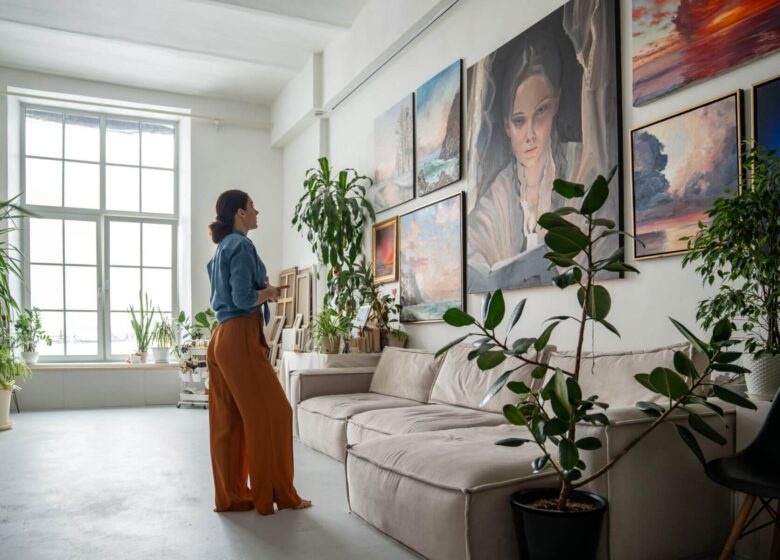
Selecting art for a residential space in the premium segment is governed by a few rules that distinguish a well-considered decision from a random one. The first of these is scale. A large empty wall in the living room of a residence is an invitation for a large-format piece – a painting that can stand on its own, without the presence of furniture or lamps. The intimate space of a study or library, on the other hand, is the place for prints, drawings or small canvases that reward close inspection and viewing at arm’s length.
The second rule is authenticity of provenance. A work with a history – from an exhibition, an auction house, or an established artist – brings something to the space that cannot be replicated: context. A buyer who asks about a painting on the wall and hears a specific story in response leaves the property viewing with more than just an aesthetic impression. They leave with the feeling that they have been in a place that someone has thoughtfully curated.
The third rule is coherence without uniformity. A collection in a premium property need not be monographic – it need not consist solely of works by a single artist or a single movement. It must, however, speak internally: through mood, through colour palette, through the level of formal discipline or its deliberate absence. An interior where an Impressionist landscape sits alongside aggressive abstraction and documentary photography does not tell a story – it is merely a storage space.
The fourth, often underestimated rule is light. Art lives in light. Oil paintings and watercolours require completely different lighting. A sculpture needs a side light source to bring out its texture. Black-and-white photography can withstand cool LEDs, which would kill the warmth of any canvas. Ignoring these relationships is one of the most common mistakes, even in very expensive interiors.
Art advisor – a role for which the market in Poland is just maturing
In countries where the premium property market has a longer history – in the UK, France, Germany and the Nordic countries – it is standard practice for the owner of a residence to work with an art advisor. This is not an interior decorator or an art dealer. It is a specialist who understands both the art market – its cycles, artists, institutions and valuation mechanisms – and the specific nature of the space for which they are working.
An art advisor does not sell specific works. They recommend, contextualise, negotiate, ensure authenticity and provenance, and over time become something of a collection architect. In Poland, this role is only just gaining recognition, but in the top segment it is already present and increasingly in demand.
Vilea Property Boutique is one of the few premium estate agencies in Poland that provides its clients with access to art advisors – specialists who assist both sellers in preparing properties for sale and buyers seeking spaces with a specific artistic character. This service stems directly from market observations: clients in the premium segment are increasingly asking not only about floor space and location, but also about what hangs on the walls – and whether they can rely on it. After their purchase, Vilea Property Boutique clients benefit from the art advisor’s guidance in selecting works for the collection that adorns their interiors.
Art and the market value of property
The link between the presence of art and the valuation of premium property is difficult to measure, but easy to observe in practice. Properties with well-curated collections achieve higher sale prices – not because the buyer is paying for the paintings, but because they are paying for the space that the paintings help to create. It is a subtle but real difference.
This is confirmed by observations from agencies operating in the top segment of Western markets: the presence of an art collection – particularly works with verifiable provenance, with a history of purchase at renowned auction houses or galleries – shortens the time from the first viewing to the signing of the deed and limits price negotiations. A buyer who feels they have stumbled upon something exceptional is less likely to negotiate. They know that uniqueness comes at a price.
In the context of preparing a luxury property for sale, this translates into a specific recommendation: before you decide on yet another refurbishment to refresh the bathroom or replace the flooring, ask an art adviser whether the space already has its own character. Sometimes a single large canvas achieves more than thousands of zlotys spent on new fittings.
Does the buyer purchase the property along with the artworks? This varies, and in most cases it does not happen. However, the presence of carefully selected paintings or sculptures influences how a prospective buyer perceives the property. The property appears unique and full of character. The buyer gains an idea of how the interiors will look with their own collection, selected with the help of an art adviser, or independently if they possess the relevant knowledge.
A property with a collection – an experience, not a product
There is something in the nature of art that changes the way people experience a space. An interior without art – even one furnished very expensively – is a product. An interior with art selected with intention is a place. And places, not products, are what buyers in the premium segment are willing to pay above-average prices for – and what they continue to think about long after signing the deed.
For sellers, this is a lesson worth remembering. For buyers – a reason to look not only for square metres and an address, but for a space that already has a certain character. For agencies – such as Vilea Property Boutique – this is a reason to view a property not only through the prism of location and standard of finish, but also through the prism of what it says. What it says about the person who created it. And whether that story will reach the right listener.
Art in premium property is not an afterthought. It is part of the language through which the top-tier market communicates. It is worth knowing this language – and it is worth having someone to help you speak it.
Photo: DimaBerlin
Author: Adrian Kołodziej